DataHeartbeats
Built for us, grown beyond us
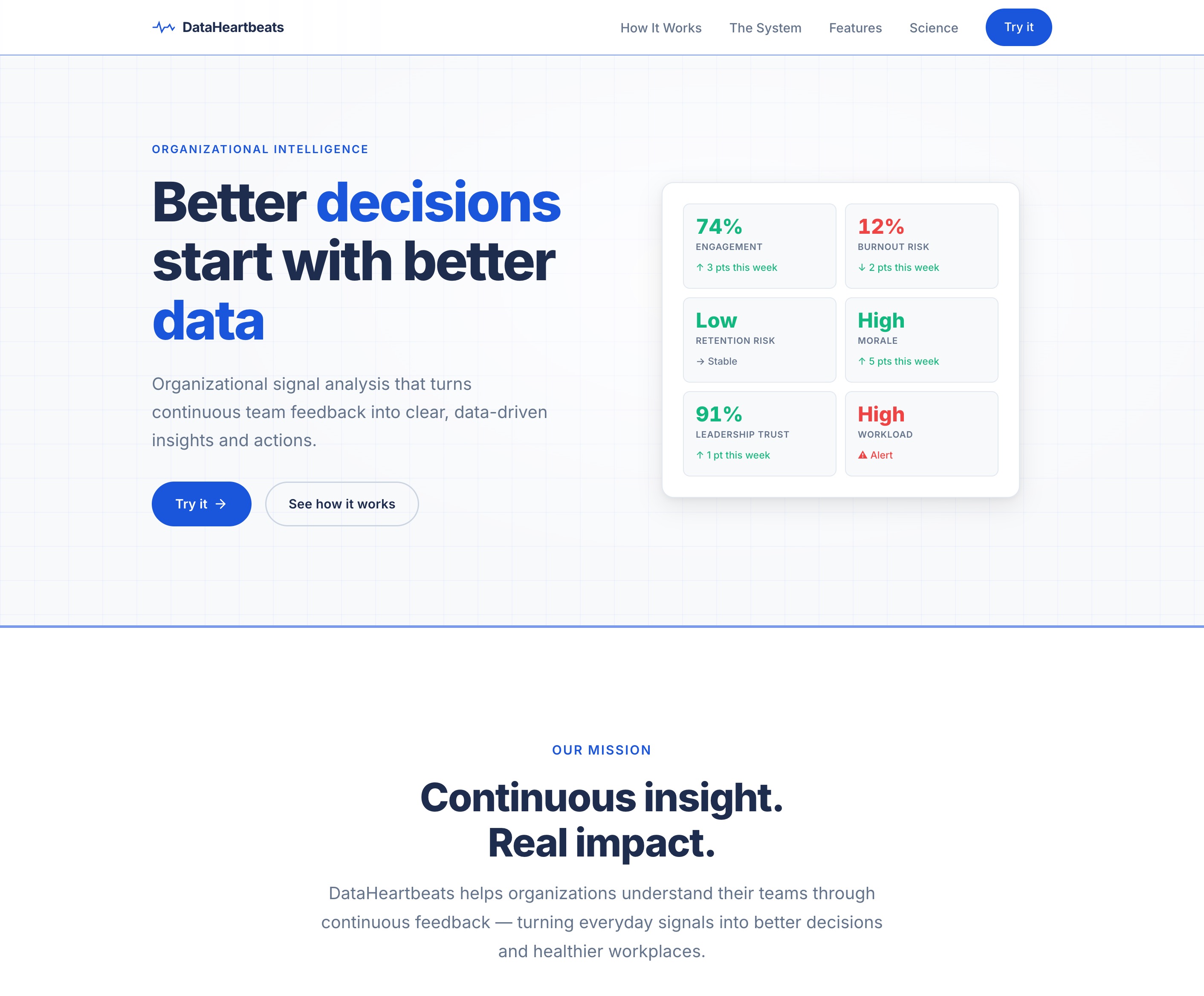
An internal tool we built to understand our own teams, that turned into a platform organisations use to detect burnout before it happens.
Introduction
DataHeartbeats started as an internal question: how do we actually know how our team is doing? Not from a quarterly survey, but continuously, in a way that respects anonymity and takes only minutes a week. We built the first version for ourselves and our partner companies, and it kept growing.
The Challenge
The Gap Between Signals and Action
Traditional HR tools rely on annual reviews and gut-feel. By the time a retention risk is visible, it has usually been building for months. We needed something scientifically sound, lightweight enough that people would actually use it, and anonymous enough that they'd be honest. Nothing on the market fit that description, so we built it.
What We Built
Continuous Pulse Checks
3-minute weekly check-ins across mood, energy, stress, sleep, morale, and connection
Psychometric Foundation
Built on IRT (Item Response Theory) and validated psychological constructs, not just averages
Team Intelligence Dashboard
Aggregated signals, trend lines, and burnout risk indicators for managers without individual data exposure
100% Anonymous Architecture
Individual responses are never surfaced; only aggregated patterns reach the dashboard
The Approach
Partner-First, Then Market
We deployed DataHeartbeats first within Developers Alliance and a small circle of partner companies. This gave us real usage data, honest feedback, and edge cases we'd never have found in a sandbox. The tool outgrew the original circle quickly, organisations outside our network started asking to use it.
Technology
How It Works Under the Hood
Built on Python/Flask with a PostgreSQL/Supabase backend. The scoring engine uses statistical modelling and IRT to turn raw responses into calibrated signal scores. Architecture is deliberately simple to ensure sub-second response times and auditability.
Python / Flask backend
PostgreSQL + Supabase
IRT / Psychometric scoring engine
Statistical signal modelling
Anonymous data architecture
Sub-second API response times
The Results
Measurable Outcomes for Organisations
6 weeks
Earlier burnout detection vs traditional methods
<3 min
Per team member per week
100%
Anonymous, zero individual data exposure
Multi-org
Deployed across partner network and beyond
Conclusion
From Internal Tool to Platform
DataHeartbeats is proof that the best products often come from solving your own problems honestly. We needed something our own teams would actually use, so we built something simple, science-backed, and genuinely anonymous. That combination turned out to be what many organisations had been waiting for.
We continue to develop and operate DataHeartbeats as part of our internal tooling and offer it to partner organisations. We built it because we needed it, and we keep working on it because other teams need it too.
Interested in DataHeartbeats for your organisation?
Whether you want to deploy it for your team or discuss a custom wellbeing intelligence solution, we'd love to talk.